




In today’s real-time digital experiences, a communication API for voice calls and communication is no longer just about broadcasting sound—it’s about enabling meaningful, two-way conversations.
From AI voice agents to customer support systems and multiplayer apps, developers increasingly need voice solutions that can listen, respond, and adapt in real time.
This article explores which platforms truly support bidirectional voice interactions, what capabilities matter most, and how to evaluate the right communication API for voice for your product.
What does two-way voice communication really mean?
At its core, two-way voice communication allows both parties in a session to send and receive audio in real time.
A modern communication API for voice typically goes beyond basic call handling and includes real-time streaming, low-latency processing, and integration with AI or backend logic.
Why a communication API for voice matters in modern apps

Two-way voice is now central to many product categories:
- Conversational AI and voice assistants
- Live customer support and call centers
- Telehealth and remote consultations
- Gaming and social audio platforms
A robust communication API for voice lets developers focus on user experience instead of telecom complexity. As noted by Amazon Alexa Developers: “Voice-based interfaces are becoming a primary way users interact with technology.”
This shift makes choosing the right API a strategic decision, not just a technical one.
Key features to look for in a voice communication API

Before comparing providers, it’s important to understand the features to look for in a voice communication API and closely related variations.
Not all APIs marketed as “voice-enabled” support true bidirectional communication.
Core capabilities to prioritize
- Real-time audio streaming rather than recorded playback
- Low-latency performance, ideally under 300 milliseconds
- WebSocket or WebRTC support
- Scalable concurrent sessions
- SDKs for web, mobile, and server environments
A strong communication API for voice should also support interruptions, barge-in, and dynamic routing, especially for AI-driven conversations.
Advanced capabilities worth considering
- Speech-to-text and natural language processing hooks
- AI-driven response generation
- Call control such as mute, transfer, hold, and end
- Compliance support for GDPR, HIPAA, or SOC 2
Leading platforms that support two-way communication
Twilio programmable voice
Twilio is often the first name developers consider when evaluating an API. It supports inbound and outbound calls, real-time media streaming, and extensive call control features.
Key strengths include global infrastructure, real-time media streams, and a mature developer ecosystem. One tradeoff is that costs can scale quickly at higher volumes.
Vonage voice API
Vonage provides a flexible API focused on programmability and global reach. It supports two-way calling, speech recognition, and real-time event handling.
Notable advantages include strong call control APIs, built-in speech recognition options, and competitive international pricing.
Agora real-time engagement platform
Agora is widely used for real-time voice and video use cases such as gaming, social audio, and live events.
While not telecom-first, it excels at low-latency audio exchange.
Google speech and telephony integrations
Google offers components that can be combined into an API, particularly when paired with Dialogflow and telephony partners.
These tools are often used for AI-driven phone agents and IVR systems that rely on natural language understanding.
How a text-to-speech API enhances a communication API for voice
Listening is only half of a conversation.
To respond naturally, applications need realistic voice output, which is where text-to-speech becomes essential.
When paired with a communication API for voice, text-to-speech allows systems to generate spoken responses dynamically instead of relying on static recordings.
This is especially important in AI-driven voice agents, where responses must be generated in real time based on user intent, conversation history, or backend data.
Typecast for expressive voice responses
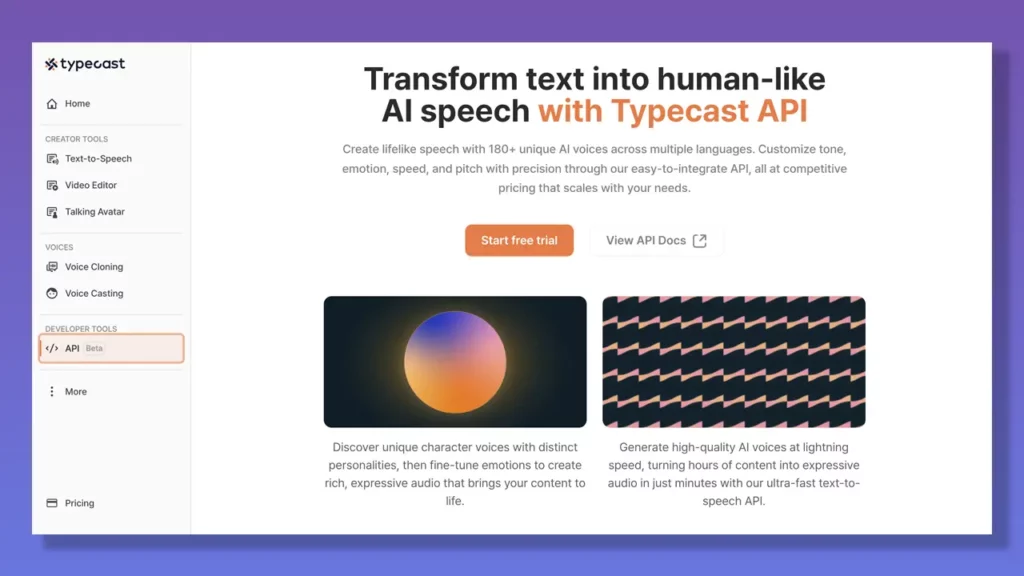
One platform focused on high-quality synthesized speech is Typecast.
Its text-to-speech API enables developers to generate expressive, character-rich voice output that can plug directly into a communication API for voice workflow.
This combination allows applications to:
- Turn AI-generated text into natural-sounding speech
- Maintain consistent voice personas across interactions
- Deliver more human-like, emotionally nuanced responses
By integrating expressive speech generation with real-time audio streaming, developers can move beyond robotic prompts and create conversations that feel more lifelike and engaging.
Comparing use cases by industry

Customer support and call centers
These environments require reliability, call routing, monitoring, and analytics. A communication API for voice must handle peak volumes while maintaining clarity and uptime.
AI voice agents and assistants
For AI-driven experiences, latency and interruption handling are critical. APIs must support fast turn-taking and real-time audio exchange to feel natural.
Social and multiplayer applications
Group audio, spatial sound, and ultra-low latency often matter more than traditional phone connectivity. Some teams choose real-time engagement platforms instead of classic telecom APIs.
How to choose the right communication API for voice
There is no single best solution for every product. When evaluating a communication API for voice, consider questions such as:
- Do you need PSTN calling, app-to-app voice, or both?
- How important is latency compared to call stability?
- Will AI or automation be part of your roadmap?
A future-ready communication API for voice should scale alongside your product and adapt as user expectations evolve.
As noted by MIT Technology Review: “The future of voice is conversational, contextual, and continuous.”
Final thoughts
Two-way voice communication has shifted from a specialized feature to a core requirement. Whether you’re building an AI assistant, a customer support platform, or a social experience, choosing the right communication API for voice will directly shape how users interact with your product.
By understanding real-time performance needs, extensibility, and the features to look for in a voice communication API, teams can design voice experiences that feel natural, responsive, and genuinely human.