





When building voice-enabled applications, API SSML support can make the difference between robotic-sounding audio and natural, expressive speech.
Understanding which text-to-speech platforms offer comprehensive SSML capabilities is essential for developers seeking precise control over speech output.
Speech Synthesis Markup Language (SSML) allows developers to fine-tune pronunciation, pacing, emphasis, and emotional tone.
Without robust SSML support in APIs, creating professional-grade voice experiences becomes significantly more challenging. Let’s explore the leading platforms and evaluate their SSML capabilities.
What is SSML and why does it matter?

SSML is an XML-based markup language that gives developers granular control over synthesized speech.
Rather than relying solely on an engine’s default interpretation, SSML tags let you specify exactly how text should be spoken.
Key SSML elements include:
- Prosody: Controls pitch, rate, and volume
- Break: Inserts pauses of specified durations
- Emphasis: Adds stress to particular words
- Say-as: Dictates how content like dates, numbers, or abbreviations should be pronounced
- Phoneme: Provides explicit phonetic pronunciation
- Voice: Switches between different voice profiles
As noted by the W3C, the organization maintaining SSML standards:
“SSML provides a standard way to control aspects of speech such as pronunciation, volume, pitch, and rate across different synthesis-capable platforms.” — W3C Speech Synthesis Markup Language Specification
Top APIs with excellent SSML support
Several major cloud providers have invested heavily in their text-to-speech offerings, each bringing unique strengths to their SSML implementations.
Understanding the nuances between these platforms helps developers make informed decisions based on their specific project requirements.
Below, we examine the leading contenders and break down what makes each platform’s API SSML support stand out from the competition.
Amazon Polly
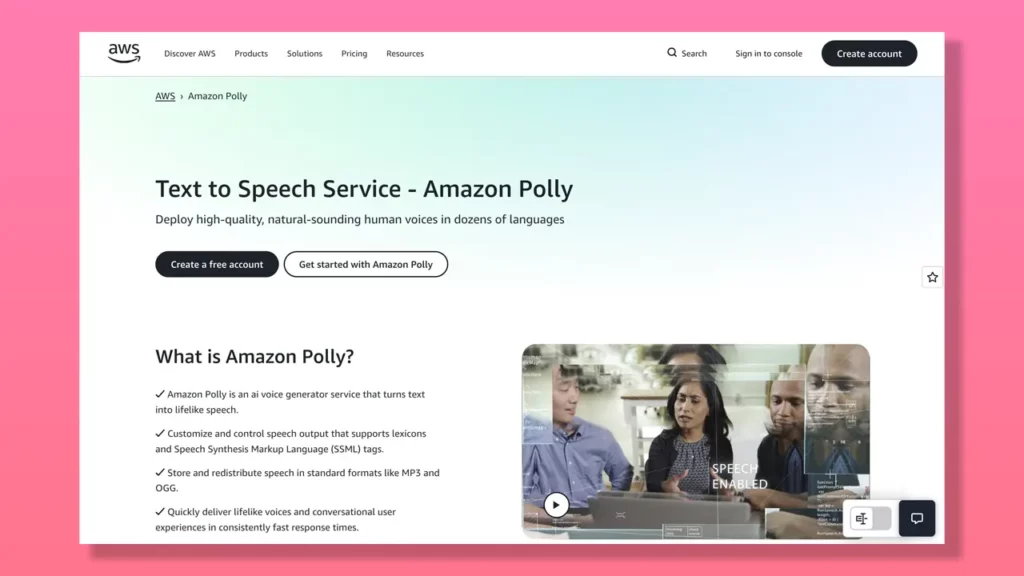
Amazon Polly stands out for its comprehensive speech synthesis API SSML implementation.
The service supports virtually all standard SSML tags plus proprietary extensions for enhanced functionality.
Notable Polly SSML features:
- Amazon-specific tags like
<amazon:breath>for natural breathing sounds <amazon:auto-breaths>for automatic breath insertion- Neural voice support with SSML compatibility
- Whispered speech effects using
<amazon:effect name="whispered">
Polly’s documentation explicitly states support for prosody modifications ranging from x-slow to x-fast for rate and x-soft to x-loud for volume adjustments.
Google Cloud Text-to-Speech
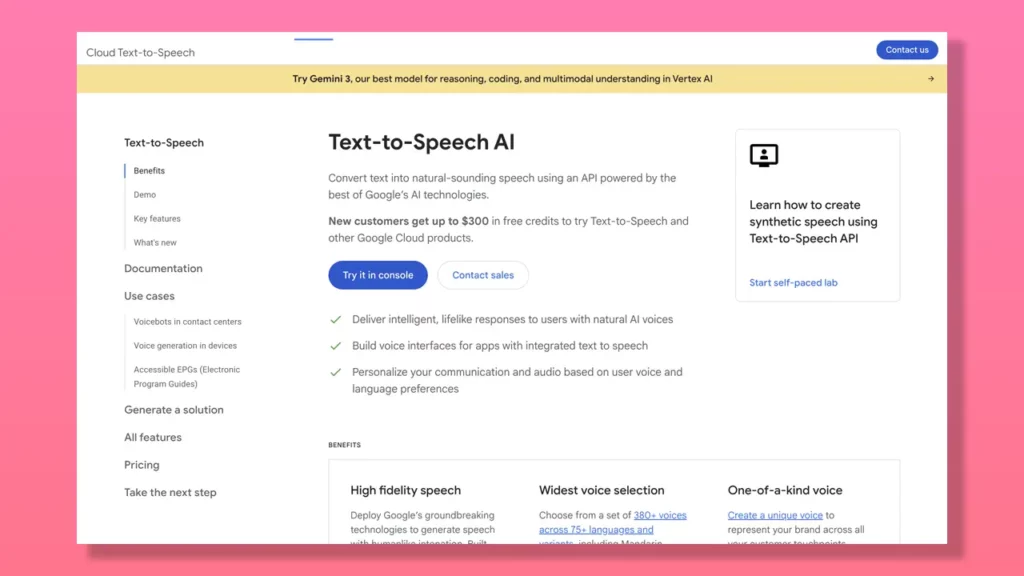
Google’s offering provides robust API SSML support with extensive tag compatibility. Their WaveNet and Neural2 voices work seamlessly with SSML markup.
Key strengths include:
- Full prosody control including semitone-level pitch adjustments
- Audio profiles optimized for different devices
- Support for speaking rate modifications from 0.25x to 4.0x
- Comprehensive say-as interpretations for multiple data types
According to Google’s developer documentation:
“SSML gives you more control over how Cloud Text-to-Speech generates audio from your input text.” — Google Cloud Text-to-Speech Documentation
Microsoft Azure Speech Service

Microsoft Azure offers one of the most feature-rich SSML implementations available.
Their Speech Service supports standard SSML plus numerous Microsoft-specific extensions.
Standout capabilities:
<mstts:express-as>for emotional speaking styles- Background audio mixing with
<mstts:backgroundaudio> - Silence insertion with precise millisecond control
- Custom neural voice support with full SSML compatibility
Azure’s platform enables developers to create genuinely expressive speech by combining standard tags with proprietary emotional controls.
IBM Watson Text to Speech
IBM Watson provides solid SSML support with particular strength in enterprise applications.
Their implementation covers core SSML tags while adding useful extensions.
Watson’s SSML features include:
- Transformation element for voice customization
- Expression tags for emotional variation
- Standard prosody and break controls
- Phoneme support using IPA notation
Non-SSML alternatives worth considering
While API SSML support remains valuable for many developers, not every project requires manual markup control.
Typecast API
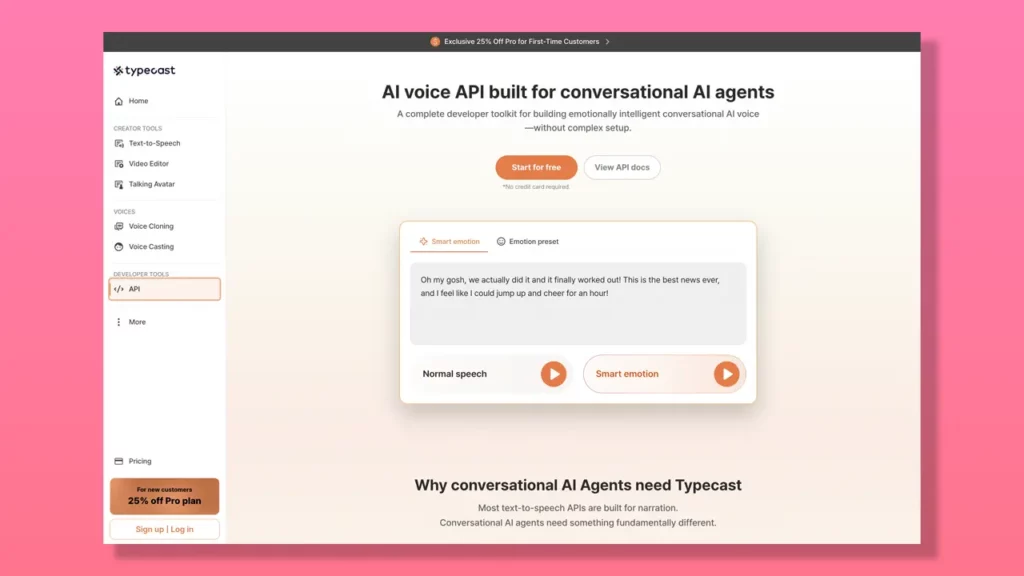
The text-to-speech API offering from Typecast offers a compelling alternative approach.
Rather than relying on SSML tags for expressiveness, Typecast leverages advanced AI voice actors that deliver natural emotion and intonation without manual markup.
This approach offers several advantages:
- Reduced development complexity
- No need to learn SSML syntax
- Naturally expressive voices out of the box
- Faster implementation for many use cases
For developers prioritizing speed and simplicity over granular control, Typecast provides an excellent option that achieves expressive results through superior underlying voice technology rather than manual tagging.
How to choose the best TTS API for your needs

Selecting the right platform depends on several factors beyond SSML capabilities. Consider these evaluation criteria:
Voice quality and naturalness
While SSML support in speech APIs provides control, the underlying voice quality matters tremendously. Neural voices from major providers generally outperform concatenative alternatives.
Language and voice variety
Ensure your chosen platform supports required languages and offers sufficient voice diversity. Some APIs excel in specific language families.
Pricing structure
Costs vary significantly between providers. Amazon Polly charges per character, while others use different metrics. Calculate expected usage carefully.
Integration complexity
Evaluate SDK availability, documentation quality, and community support.
A comprehensive text-to-speech API should offer straightforward integration paths.
Common SSML implementation challenges

Even with strong API SSML support, developers face certain obstacles:
- Inconsistent tag support: Not all engines interpret every tag identically
- Voice-specific limitations: Some tags only work with particular voices
- Performance considerations: Complex SSML can increase processing time
- Testing requirements: Extensive testing ensures consistent output across scenarios
Best practices for SSML development
To maximize your SSML implementation success:
- Start with standard tags before exploring proprietary extensions
- Test thoroughly across target voices and platforms
- Use phoneme tags sparingly for genuinely problematic words
- Document your SSML patterns for team consistency
Conclusion
The leading cloud providers—Amazon, Google, Microsoft, and IBM—all offer substantial API SSML support for text-to-speech applications.
Amazon Polly and Microsoft Azure currently provide the most extensive proprietary extensions, while Google offers excellent standard compliance with superior neural voice quality.
However, developers should also consider whether SSML is truly necessary for their projects.
Platforms like Typecast demonstrate that expressive, natural speech can be achieved through advanced AI voices without manual markup, potentially simplifying development workflows.
Your choice should balance SSML capabilities with voice naturalness, pricing, and integration requirements.
Whether you select the best TTS API with comprehensive SSML or opt for a naturally expressive alternative, the goal remains the same: creating genuinely engaging voice experiences that captivate users and elevate applications.