





Voice API integration is no longer a niche capability—it’s the backbone of modern customer communication.
Whether you’re embedding click-to-call in a mobile app or orchestrating global call routing, voice API integration determines how seamlessly your product connects users in real time.
But not all platforms are created equal. From call control and scalability to compliance and AI-powered enhancements, API integration features vary widely.
Understanding these differences can help businesses choose the right solution for their communication stack.
What is voice API integration and why does it matter?

At its core, voice API integration allows developers to embed calling capabilities directly into apps, websites, or backend systems using programmable interfaces.
This enables:
- In-app calling
- Call routing and forwarding
- Interactive voice response (IVR)
- Call recording and analytics
- AI-powered speech automation
As Gartner explains, cloud communication APIs are transforming customer engagement by allowing companies to “compose communications into business processes and applications.”
The strength of your API integration determines how flexible and scalable those communications can be.
Core call control capabilities in voice API integration

One of the biggest differentiators among platforms is how much control developers have over live calls.
Basic call handling
Most providers support:
- Outbound and inbound calling
- Caller ID management
- Call transfer
- Voicemail handling
However, the depth of customization varies.
Some APIs only allow simple call flows, while others let you dynamically modify call behavior mid-session using webhooks or event-driven architecture.
Advanced call orchestration
More sophisticated voice API integration solutions offer:
- Real-time call modification
- Multi-party conferencing
- Conditional call routing
- Call whispering and barge-in features
- Queue management
According to Twilio, programmable voice solutions allow developers to “control and customize every aspect of a call.”
Not every provider offers this level of granular control.
If your business depends on complex workflows—like telehealth or marketplace platforms—advanced orchestration becomes critical.
Scalability and global reach in voice API integration

Scalability is another major point of comparison.
Geographic coverage
Some platforms operate in limited regions, while others provide global carrier partnerships. This affects:
- Call quality
- Latency
- Regulatory compliance
- Local number availability
Robust API integration ensures consistent performance across borders, especially for multinational businesses.
Infrastructure and uptime
Enterprise-grade providers offer:
- Auto-scaling cloud infrastructure
- Redundant data centers
- Service-level agreements (SLAs)
According to Cisco, reliability and latency are top priorities for real-time communication services.
If uptime is mission-critical, your voice API integration must be backed by resilient infrastructure.
Security and compliance features

Security capabilities differ significantly across providers.
Encryption and data protection
Most platforms support:
- TLS for signaling
- SRTP for media encryption
- Secure token authentication
But not all include built-in fraud detection, rate limiting, or anomaly monitoring.
Regulatory compliance
For industries like healthcare or finance, compliance features may include:
- HIPAA-ready environments
- GDPR compliance tools
- PCI-compliant call recording
- Consent-based recording prompts
Choosing the right voice API integration means ensuring that your provider meets regional and industry regulations without requiring extensive custom development.
AI and automation capabilities
Modern communication platforms increasingly combine calling with AI.
Speech recognition and conversational AI
Some platforms offer built-in:
- Speech-to-text
- Intent recognition
- Natural language understanding
- AI-powered IVR
Others require third-party integrations.
Text-to-speech enhancements
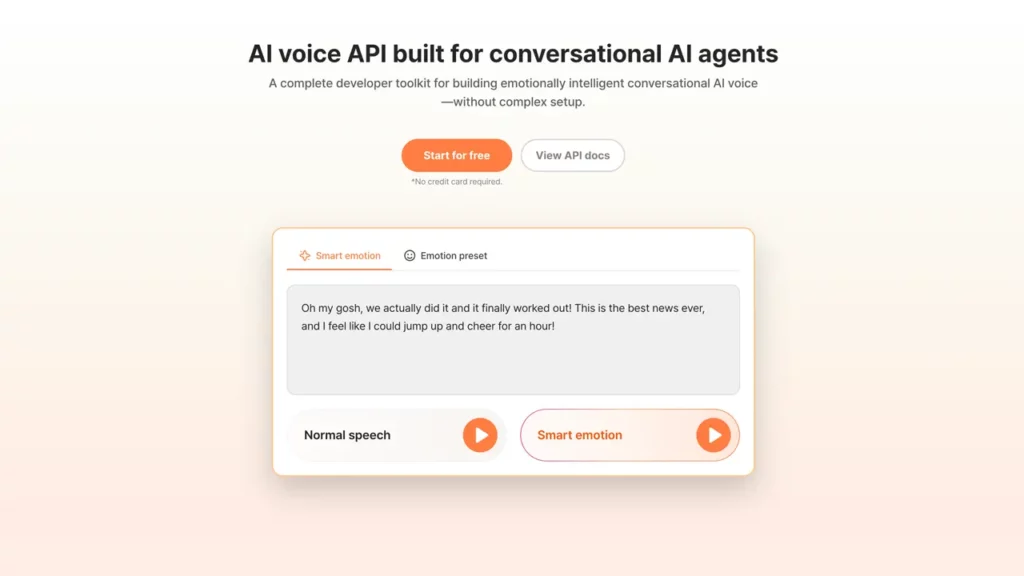
Advanced automation often depends on realistic speech synthesis.
Integrating a text-to-speech API like Typecast AI can elevate IVR systems, virtual assistants, and automated notifications with human-like voices.
When comparing platforms, check whether AI capabilities are native or require additional configuration within your voice API integration.
Developer experience and customization
The flexibility of voice API integration often comes down to developer tooling.
SDKs and documentation
Look for:
- RESTful APIs
- WebSocket support
- Mobile SDKs (iOS/Android)
- Server-side libraries
- Clear documentation and code samples
Poor documentation can dramatically slow down deployment—even if the feature set is strong.
Event-driven architecture
Some platforms allow real-time event callbacks for:
- Call answered
- Call failed
- DTMF input received
- Recording completed
This enables reactive systems that adjust dynamically during live calls, making the API integration more intelligent and responsive.
Pricing models and cost transparency

Cost structures vary widely and influence integration decisions.
Common pricing structures
- Per-minute billing
- Per-call billing
- Subscription tiers
- Add-on pricing for advanced features
Hidden fees—like number rental or recording storage—can significantly impact total cost of ownership.
A transparent voice API integration provider will clearly outline usage costs and provide forecasting tools.
Ecosystem and third-party integrations
No communication platform operates in isolation.
CRM and helpdesk integrations
Many businesses rely on:
- Salesforce
- HubSpot
- Zendesk
Strong voice API integration includes prebuilt connectors or webhooks for syncing call data with external systems.
Unified communication stacks
Some providers bundle messaging, video, and a voice API into a unified communication platform. Others focus solely on voice, requiring additional vendors for omnichannel capabilities.
Choosing between specialized and all-in-one solutions depends on your long-term roadmap.
Performance monitoring and analytics

Advanced analytics distinguish basic from enterprise-ready platforms.
Key capabilities include:
- Real-time call monitoring dashboards
- Post-call analytics
- Sentiment analysis
- Quality scoring
- Call detail records (CDRs)
With robust reporting tools, businesses can continuously optimize their voice API integration for performance and customer experience.
Final thoughts
Not all voice API integration platforms deliver the same level of flexibility, scalability, or intelligence.
The differences lie in call control depth, global infrastructure, AI capabilities, compliance support, developer experience, and analytics.
When evaluating options, consider:
- How complex your call flows need to be
- Whether you require global scalability
- Your regulatory obligations
- The role of AI in automation
- Long-term cost predictability
The right voice API integration doesn’t just enable calls—it transforms communication into a programmable, data-driven asset.