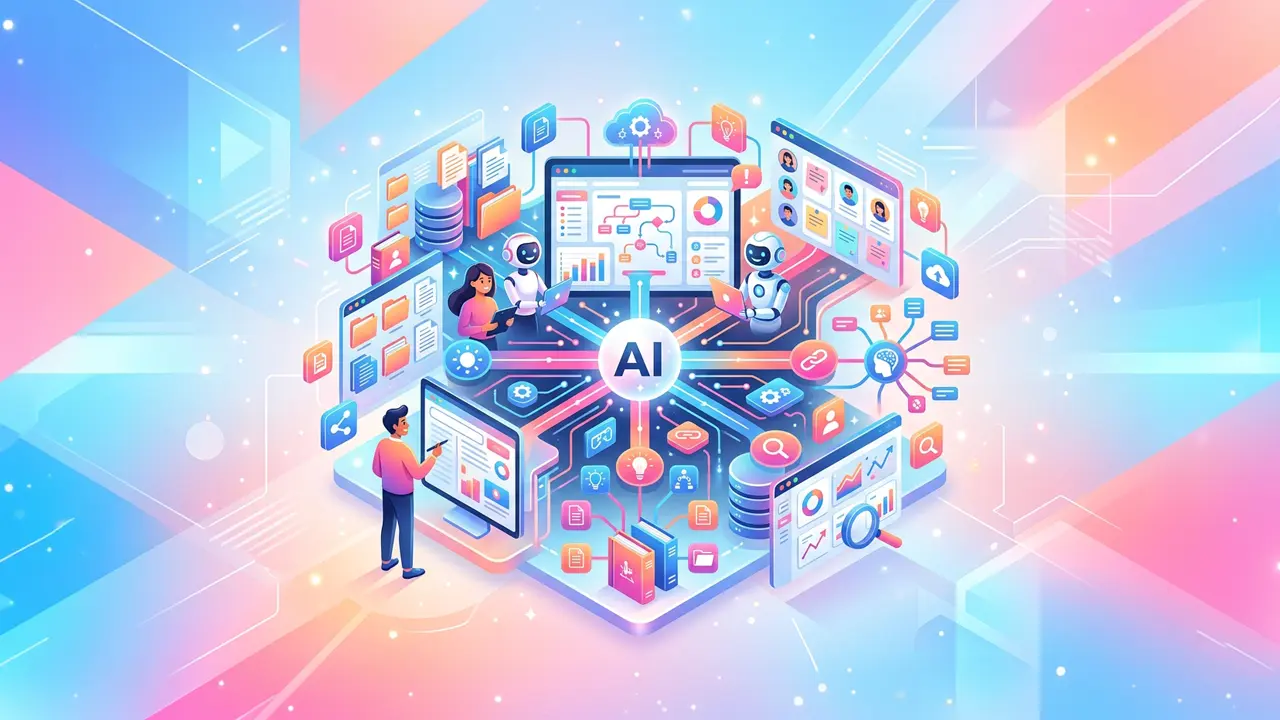





Every organization runs on knowledge — but capturing, organizing, and distributing that knowledge has always been a challenge. Knowledge management tools powered by AI are changing how businesses handle this critical function, making it easier than ever to turn scattered information into accessible, actionable insights.
Whether you’re a startup trying to preserve institutional knowledge or an enterprise managing thousands of documents, AI-enhanced knowledge management tools offer a smarter path forward. Let’s explore what makes them so valuable and how to choose the right one for your team.
Why traditional knowledge management falls short
For decades, companies relied on static wikis, shared drives, and manual tagging systems to organize internal knowledge. The problem? These systems depend on humans to consistently categorize, update, and maintain content — something that rarely happens at scale.
The result is a familiar pain point:
- Documents become outdated without anyone noticing.
- Employees spend excessive time searching for answers buried in folders.
- Critical knowledge walks out the door when experienced team members leave.
According to McKinsey, employees spend an estimated 1.8 hours per day — roughly 9.3 hours per week — searching for and gathering information. That’s a staggering amount of lost productivity that better information management tools can reclaim.
How AI transforms knowledge management tools

Intelligent search and retrieval
The most immediate benefit of AI in knowledge management tools is intelligent search. Instead of relying on exact keyword matches, AI-powered systems use natural language processing (NLP) to understand the intent behind a query and surface the most relevant results.
This means an employee can type a question like “What’s our refund policy for enterprise clients?” and get a direct answer pulled from policy documents — no folder-diving required.
Automatic content tagging and organization
AI can automatically categorize and tag documents as they’re added to a knowledge base. This eliminates the bottleneck of manual organization and ensures that new content is immediately discoverable.
Some platforms even detect duplicate or conflicting content, flagging inconsistencies before they cause confusion across teams.
Summarization and knowledge extraction
One of the most powerful capabilities is AI-driven summarization. Rather than reading through a 40-page report, users can get a concise overview of key takeaways in seconds. If your team frequently works with lengthy documents, you can also summarize PDF AI files to extract critical insights without the manual effort.
“Knowledge management is not about technology. It’s about people and how they create, share, and apply knowledge,” notes Deloitte Insights. AI simply makes each of those steps faster and more reliable.
Key features to look for
Not every AI-powered platform is built the same. When evaluating knowledge management tools, prioritize these features:
- Semantic search — Goes beyond keywords to understand meaning and context.
- Auto-categorization — Uses machine learning to tag and sort content automatically.
- Integration capabilities — Connects with tools your team already uses, like Slack, Notion, or Google Workspace.
- Analytics dashboards — Shows which content is being used, what’s outdated, and where knowledge gaps exist.
- Permission controls — Ensures sensitive information is accessible only to the right people.
These features turn a basic repository into an intelligent knowledge sharing tools ecosystem where information flows to the right people at the right time.
Real-world applications across industries

Customer support teams
Support teams use AI-powered knowledge management tools to maintain dynamic FAQ databases that update based on incoming ticket trends. Agents get instant suggested responses, reducing resolution times and improving customer satisfaction.
For teams that also produce audio-based support content or training materials, a text-to-speech API can convert written knowledge base articles into spoken guides, expanding accessibility for diverse audiences.
Sales and marketing
Sales teams benefit from centralized product knowledge that AI keeps current. When pricing, feature sets, or competitive positioning changes, the system flags outdated battlecards and suggests updates — a capability that ties directly into AI business intelligence workflows.
Internal operations
HR and operations teams use these platforms to maintain living handbooks, onboarding documentation, and compliance resources. AI ensures employees always find the latest version of a policy, reducing risk and confusion.
Getting started with knowledge management tools

Implementing AI-driven knowledge management tools doesn’t require a complete overhaul of your existing systems. Most modern platforms are designed to layer on top of your current tech stack, ingesting content from existing sources and gradually improving organization over time.
Start by identifying your biggest knowledge bottlenecks — whether that’s onboarding new hires, supporting customers, or preserving expertise from departing employees. Then pilot a solution focused on that specific pain point before scaling across the organization.
The teams that manage knowledge well don’t just work more efficiently — they make better decisions, onboard faster, and build a lasting competitive advantage that compounds over time.