





When comparing subtitles vs dubbing, the best choice depends on what viewers need from the experience, how the content will be used, and what your team can realistically review and maintain. Subtitles preserve the original audio while displaying translated text. Dubbing replaces or supplements the original spoken audio with a version in another language.
Neither format is automatically better. A short social video, a product tutorial, a training module, and a brand film may each call for a different approach. The most useful decision is usually not “subtitles or dubbing?” in isolation, but which format supports comprehension, accessibility, viewing context, and production goals for a specific audience.
The basic difference between subtitles and dubbing
Subtitles are timed on-screen text that represent spoken dialogue in another language. Depending on the project, they may also include information such as speaker identification or meaningful sound cues. Captions, in particular, are intended to communicate necessary speech and non-speech audio information for people who cannot hear the audio. That means dubbing by itself is not a substitute for captions when captions are needed for accessibility. W3C’s captions guidance explains the role of captions in making audio and video content more accessible.
Dubbing provides an alternate-language spoken track. Instead of asking viewers to read translations while watching, it lets them hear dialogue in the language selected for that version. The original visuals may remain the same, but the localized voice performance, timing, terminology, and mix require careful attention.
In practice, many localization plans use both formats. For example, a team may publish dubbed language versions for audiences who prefer spoken audio while also supplying captions or subtitles for accessibility, sound-off viewing, or viewers who want to follow the text.
Start with the audience and viewing environment
The first question is not which format is cheaper or faster. It is how the intended audience will encounter the video.
Consider subtitles when viewers are likely to:
- Watch with sound off, such as in public spaces or while scrolling social feeds
- Prefer hearing the original speaker and performance
- Need a quick way to understand content across multiple languages
- Refer back to exact wording, names, instructions, or terminology
- Use captions as an accessibility accommodation
Consider dubbing when viewers are likely to:
- Watch longer content where continuous reading could become tiring
- Need to focus on visual demonstrations, screens, or detailed actions
- Prefer spoken content in their primary language
- Be younger viewers, learners, or audiences with limited reading comfort in the source language
- Consume the video in a setting where audio is expected and available
These are not fixed rules. A viewer may prefer dubbed instructional content but choose subtitles for a short interview. Audience research, regional preferences, and the purpose of the video should guide the final decision.
Compare the viewer experience

Subtitles keep the original performance present
Subtitles allow viewers to hear the source speaker’s voice, cadence, and emotional delivery. This can be especially valuable for interviews, documentary footage, executive messages, or content where the original speaker’s identity carries meaning.
However, subtitles compete for attention with the video itself. If a video includes a product interface, charts, demonstrations, or dense visual storytelling, viewers must divide attention between reading and watching. Translation also has to fit within practical reading time and screen space, which may require concise phrasing.
Dubbing can reduce the need to read
Dubbing shifts language comprehension from the screen to the audio track. This can make visual content easier to follow because viewers are not continuously reading translated dialogue.
The trade-off is that a dubbed version introduces more editorial decisions. Teams need to evaluate pronunciation, terminology, pacing, tone, scene timing, and whether the localized voice suits the content. If viewers can still hear the original audio underneath the dub, the mix also needs to remain clear and intentional.
For content where the speaker’s personal delivery is central, a dubbed track may feel less direct than the original audio with subtitles. For content where instructions and comprehension matter most, the benefit of spoken localization may outweigh that concern.
Use the same source clip to make a practical comparison
Watch the same illustrated source in two formats
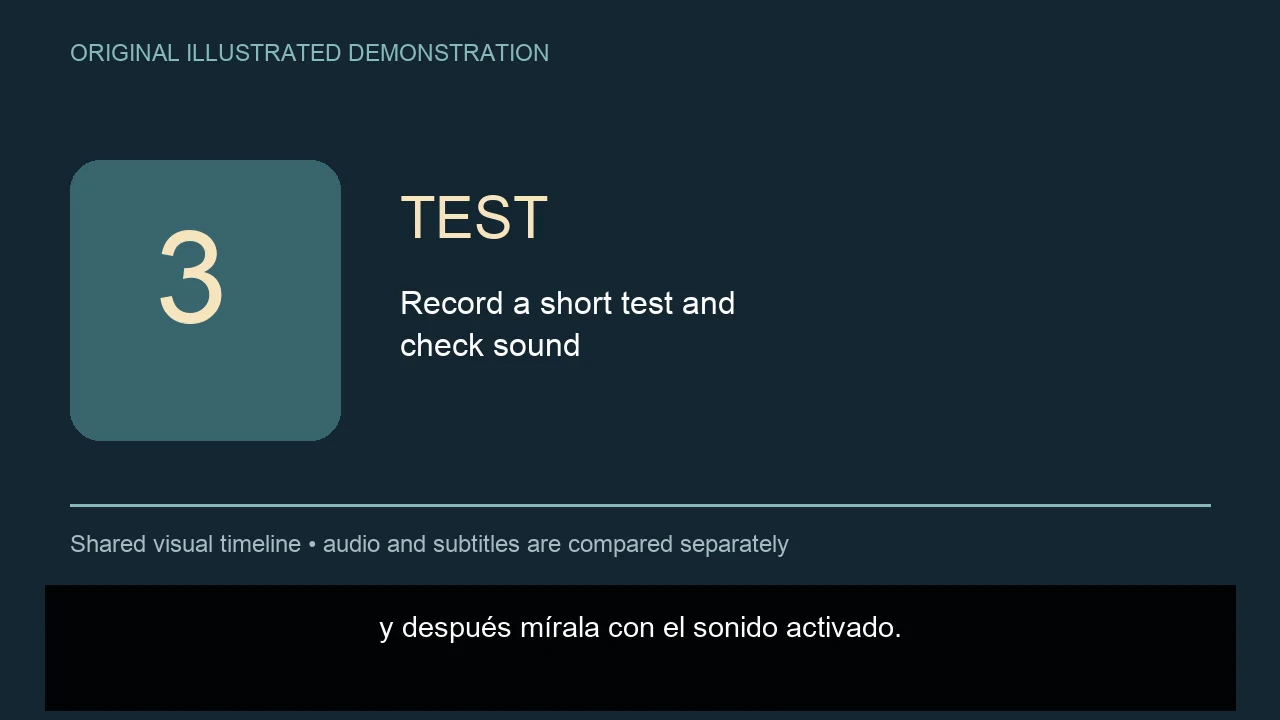
We made a 26-second instructional sample with five scene cards about recording a product video. Both versions use the identical visual timeline and Spanish as the target language. This is an illustrated demonstration, not a live-action or lip-sync test.
Version A — English narration with Spanish subtitles
Version B — Spanish dubbed narration
The original English narration lasts 21.20 seconds; the Spanish narration lasts 24.70 seconds. Both videos run for 26 seconds, with the remaining time silent. Neither recording was sped up or stretched to force a match. The longer translated reading illustrates why a dub needs a timing pass even when the message is unchanged.
Compare where your attention goes: Version A retains the English voice while asking you to read Spanish; Version B moves the translation into the soundtrack. The dub has no Spanish captions in this comparison, so it does not provide the same sound-off access. This example does not establish a universal cost, quality or comprehension advantage for either format.
A reliable way to choose between formats is to produce a small, controlled comparison from the same source clip. Select a representative section of the video rather than choosing an unusually simple or unusually complex scene.
Choose a clip that includes at least one of the following:
- Natural-paced dialogue
- Important brand or technical terms
- On-screen instructions or UI demonstrations
- A change in speaker, tone, or emotional emphasis
- Visual information that viewers should not miss
Then create two review versions: one with subtitles and one with a dubbed audio track. Keep the source visuals, target language, and intended audience consistent. This makes it easier to identify the trade-offs caused by the localization format rather than by differences in the underlying content.
Ask reviewers to assess questions such as:
1. Can viewers understand the message without missing important visuals?
2. Does the translation sound or read naturally for the target audience?
3. Are product names, legal language, and technical terms consistent?
4. Does the pacing feel comfortable for the clip’s purpose?
5. Is the content usable with sound on and sound off?
6. Does the selected format preserve the tone the original video needs?
A short side-by-side test will not answer every localization question, but it can reveal whether reading burden, timing, terminology, or voice delivery is likely to create issues at scale.
Evaluate cost and review effort as project variables

It is tempting to treat subtitles as the low-effort option and dubbing as the high-effort option. The reality is more dependent on the project.
Subtitles may require translation, timing, formatting, terminology review, and quality assurance across devices and aspect ratios. Dubbing may require translated scripts, voice selection, pronunciation review, timing adjustments, audio review, and localized export management. The number of languages, video length, update frequency, and approval requirements can affect the workload for either format.
Instead of relying on generic cost assumptions, map the work required for your actual content library. Include:
- Source-video preparation and script availability
- Translation and terminology approval
- Subtitle timing and visual QA
- Voice and pronunciation review for dubbed tracks
- Revision cycles with regional stakeholders
- Audio mixing or final delivery requirements
- Updates when source content changes
This approach helps teams compare total production effort rather than only the first version’s apparent cost. A video that changes frequently may favor a format that is easier for the team to update and reapprove. A long-lived campaign may justify more extensive localization review if it improves the experience for a priority market.
Accessibility should be a separate decision point
Do not assume that a translated subtitle file, a dubbed track, and captions are interchangeable deliverables. They serve different needs.
Captions communicate audio content, including relevant non-speech sounds, for people who cannot hear the audio. Subtitles generally focus on language translation for viewers who can hear the original soundtrack but do not understand the language. Dubbing provides alternate spoken language, but it does not convey all audio information visually. W3C guidance on captions provides a useful baseline when planning accessible audio and video experiences.
For many projects, the answer is a combination: localized audio for language access, captions for accessibility, and subtitles where translated text supports the intended viewing behavior. Confirm applicable accessibility requirements with the organization responsible for the content and its distribution.
Plan for platform and audio-track options

Distribution platforms can affect which localization strategy is practical. Some platforms support multiple audio tracks, while others may require separate localized video uploads or different publishing workflows. YouTube, for example, distinguishes manually added language audio tracks from automatically generated dubbed audio, so teams should verify how their chosen publishing method is labeled, reviewed, and managed. YouTube’s help documentation outlines this distinction.
Before committing to a format, confirm:
- Whether the platform supports alternate audio tracks
- How viewers select language options
- Whether captions and subtitles can be added separately
- Which language versions need their own metadata or uploads
- How performance will be measured by market and language
- Who owns updates when the source video changes
These operational details can influence the final choice as much as the creative preference does.
A simple decision framework
Choose subtitles first when preserving the original voice, supporting sound-off viewing, or moving quickly across many language versions is the main priority.
Choose dubbing first when viewers need to focus on complex visuals, are likely to prefer spoken content in their language, or will watch longer-form material where reading may create friction.
Use both when the video must support multiple viewing preferences and accessibility needs. In many cases, a dubbed language track plus appropriately prepared captions offers a more flexible experience than either format alone.
If you are building the audio version of a localized video, start with a clear translated script and a representative test clip. You can also explore how to create a text-to-speech voiceover as part of a workflow for evaluating timing, pronunciation, and delivery before finalizing a broader production plan.
For a step-by-step overview of multilingual voiceover planning, review the AI dubbing guide.
Make the choice based on the job the video must do
The subtitles vs dubbing decision is ultimately a communication decision. Subtitles can preserve the original performance and support viewers who need text on screen. Dubbing can make spoken content easier to follow in another language and reduce competition between text and visuals.
Use the same source clip to test both formats, review the result with people who understand the target audience, and account for accessibility separately from translation. That process produces a more useful answer than treating one localization format as universally better than the other.