





Every organization reaches a point where manual workflows start holding teams back. Learning how to automate business tasks is one of the fastest ways to reclaim lost hours, reduce errors, and let your people focus on work that actually moves the needle.
Whether you run a lean startup or manage operations inside a large enterprise, business task automation has become less of a luxury and more of a survival skill in today’s competitive landscape.
Why companies are racing to automate repetitive tasks

The push to automate repetitive tasks is backed by hard numbers. According to McKinsey, roughly 60 percent of all occupations have at least 30 percent of activities that could be automated with current technology. That represents an enormous amount of time spent on predictable, rule-based work that software can handle faster and more accurately.
Common tasks ripe for automation include:
- Invoice processing and accounts payable — data entry, approval routing, and payment scheduling.
- Email follow-ups and lead nurturing — triggered sequences based on customer behavior.
- Employee onboarding — document collection, account provisioning, and training assignments.
- Inventory management — reorder alerts, stock-level syncing across platforms.
When teams stop doing these things by hand, they don’t just save time — they eliminate the small mistakes that snowball into costly problems.
How to identify which tasks to automate first
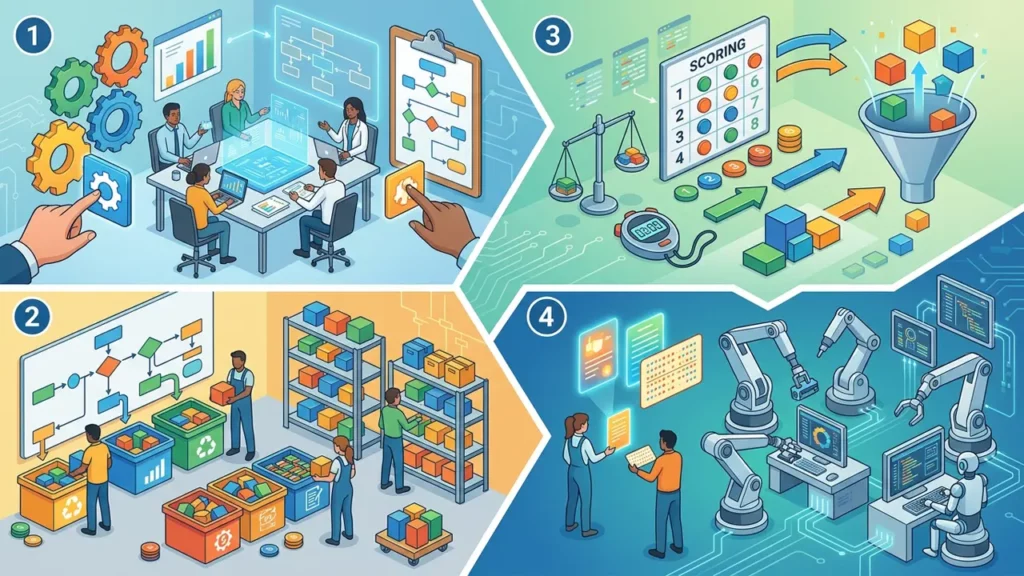
Not every process deserves automation on day one. A practical starting point is to audit your workflows with three simple questions:
- Is the task performed frequently? Daily or weekly tasks offer the highest return.
- Is it rule-based? If the steps follow a predictable “if-this-then-that” logic, automation fits naturally.
- Does it create bottlenecks? Tasks that stall other people’s work should jump to the top of the list.
“The first rule of any technology used in a business is that automation applied to an efficient operation will magnify the efficiency.” — Bill Gates
Map these tasks visually, rank them by impact, and start with one or two quick wins before tackling more complex processes. This approach builds internal confidence and creates momentum for bigger automation projects.
Choosing the right task automation tools

The market is flooded with task automation tools, so picking the right ones depends on your specific needs and technical comfort level. Here’s a quick breakdown of popular categories:
No-code and low-code platforms
Tools like Zapier, Make (formerly Integrobot), and Microsoft Power Automate let non-technical users connect apps and build automated workflows without writing a single line of code. They’re ideal for small teams that want to automate business tasks quickly.
AI-powered automation software
Platforms such as UiPath, Automation Anywhere, and Salesforce Einstein go deeper. They use artificial intelligence to handle unstructured data, make decisions, and learn from patterns over time. If you’re already exploring AI business intelligence, these tools integrate naturally into your data ecosystem.
Communication and content tools
Automation isn’t limited to back-office operations. An AI voice generator can produce professional voiceovers for training videos or marketing content in minutes, eliminating the need to book studios and talent.
These creative efficiencies add up fast.
Step-by-step process to automate business tasks
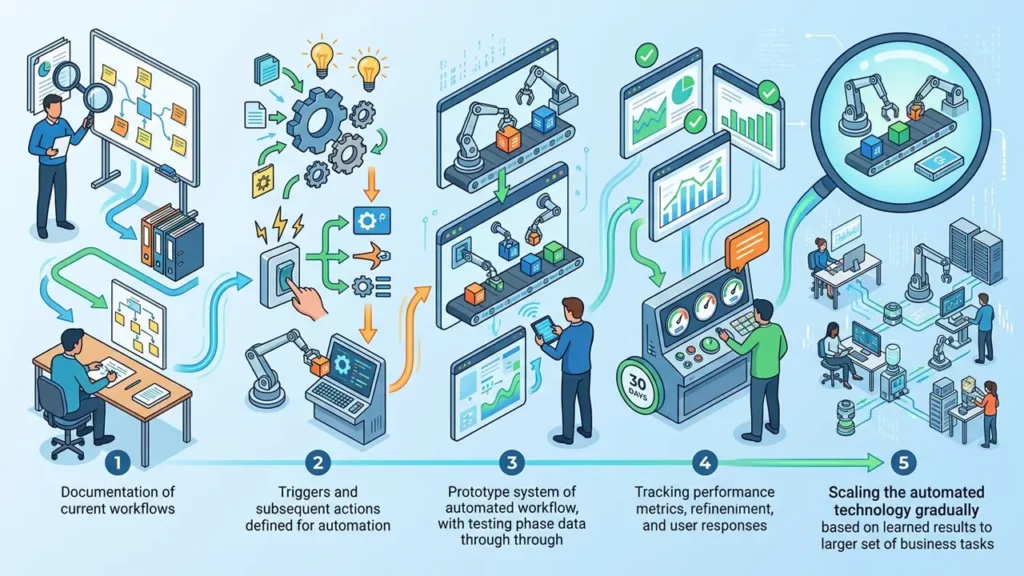
Once you’ve selected your tools, follow a structured rollout:
- Document the current workflow — Write down every step, decision point, and handoff.
- Define triggers and actions — Identify what starts the process and what should happen at each stage.
- Build a prototype — Create a minimal version of the automated workflow and test it with real data.
- Monitor and refine — Track error rates, processing times, and user feedback for the first 30 days.
- Scale gradually — Apply lessons learned to the next set of tasks.
This structured method prevents the common mistake of automating a broken process, which only produces broken results faster.
Weighing the trade-offs

No technology shift comes without considerations. It’s worth reviewing the broader advantages and disadvantages of AI before committing to large-scale automation.
On the plus side, you gain speed, consistency, and scalability. On the other hand, over-automation can remove the human judgment that certain decisions require, and poorly configured workflows can create new problems.
The smartest organizations treat automation as a partnership between people and technology — not a replacement of one by the other.
Where to go from here
The companies seeing the best results from automated business tasks are the ones that treat it as an ongoing discipline rather than a one-time project. Start small, measure everything, and expand methodically.
As AI capabilities continue to advance, the gap between businesses that embrace task automation and those that don’t will only widen. The best time to start was yesterday — the second-best time is right now.