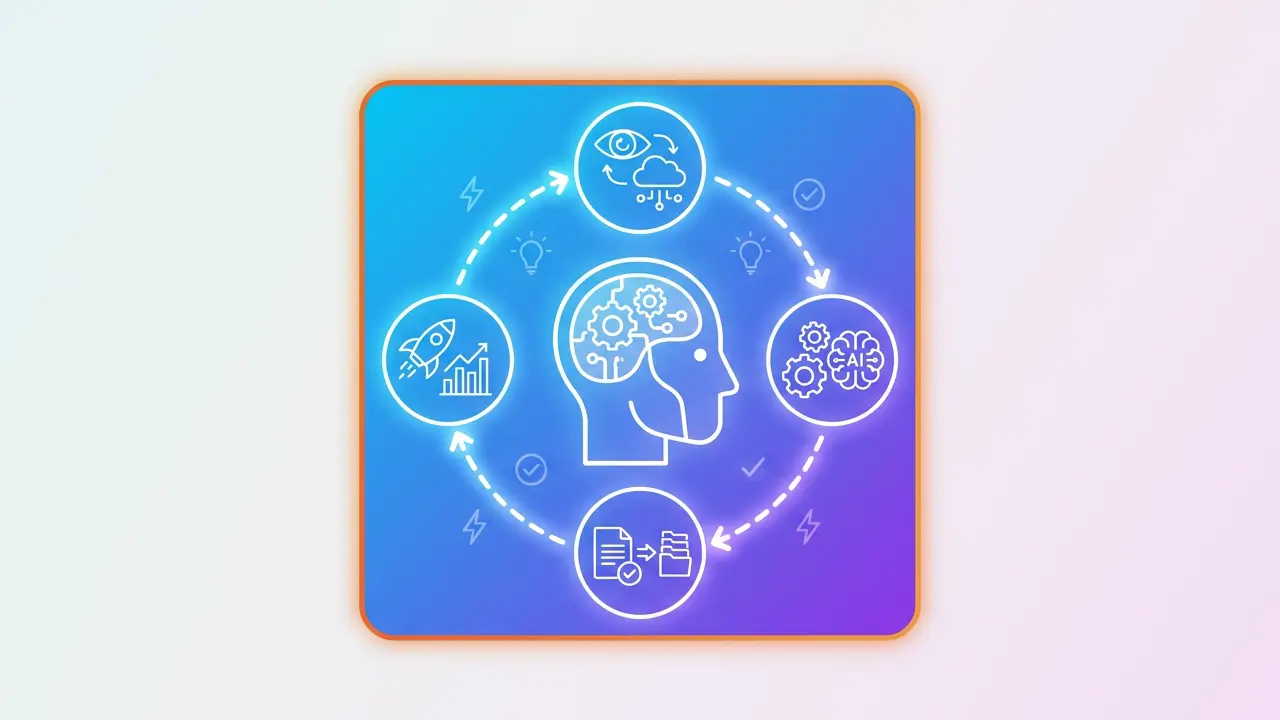





AI workflow automation is rapidly transforming the way businesses operate by combining the power of artificial intelligence with traditional process management.
Instead of relying on employees to manually move tasks from one stage to the next, intelligent systems now handle that work with greater speed, accuracy, and consistency.
At its core, this technology uses AI to design, manage, and continuously optimize sequences of business tasks that previously required hands-on human involvement at every step.
How AI workflow automation works
Traditional automation operates on fixed rules—if this happens, then do that.
AI workflow automation takes things much further by introducing systems that can learn from data, interpret context, and make nuanced decisions without waiting for human input.
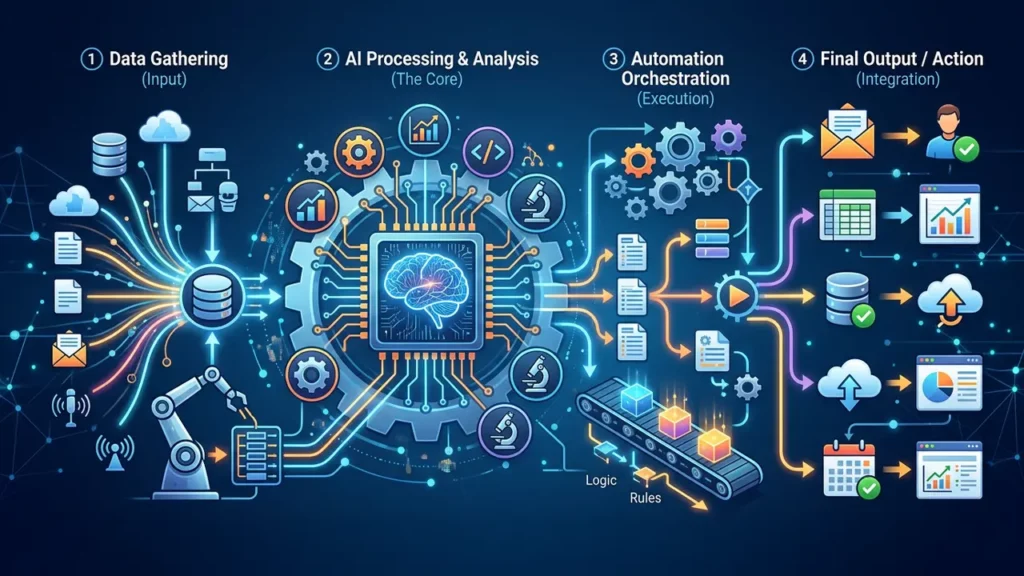
Here’s how a typical process unfolds:
- Data ingestion: The system pulls information from sources like emails, databases, forms, and third-party applications.
- Intelligent analysis and routing: AI evaluates the data, classifies it, and determines the most appropriate next action based on patterns it has learned over time.
- Automated task execution: The system carries out actions such as sending notifications, updating records, generating documents, or escalating issues to the right team member.
- Continuous improvement: With each completed cycle, the system refines its decision-making by analyzing outcomes and adjusting its logic accordingly.
As McKinsey highlights:
“AI-driven automation can reduce manual processing time by up to 50 percent in many back-office functions.” — McKinsey & Company
This capacity for learning and adaptation is what fundamentally separates AI-powered systems from basic workflow automation software that simply follows static instructions.
Why businesses are embracing it

Saves significant time and money
Manual workflows consume enormous amounts of employee time on tasks like data entry, status updates, routing approvals, and compiling reports.
When organizations automate business processes, those hours are freed up for strategic, creative, and higher-value work that actually drives growth.
Dramatically reduces human error
Even the most diligent employees make mistakes when they’re fatigued or overwhelmed, but AI systems operate with unwavering consistency, catching anomalies and maintaining accuracy across thousands of transactions without breaking a sweat.
Scales with your business
A manual process that functions smoothly with ten daily orders will almost certainly collapse under the weight of a thousand, whereas AI workflow automation scales gracefully without requiring proportional increases in headcount or resources.
Common workflow automation examples

If you’re wondering where this technology applies in practice, here are several workflow automation examples that span a range of industries:
- Customer support: AI automatically triages incoming support tickets, assigns priority levels based on urgency and sentiment, and drafts initial responses for agents to review.
- Finance: Invoice processing, expense report approvals, and fraud detection all run on autopilot with minimal human oversight required.
- HR: Resume screening, employee onboarding checklists, and benefits enrollment are handled seamlessly from start to finish.
- Marketing: Content scheduling, lead scoring based on behavioral data, and campaign performance tracking are fully automated.
Even creative work benefits from this shift.
For instance, an AI voice generator can produce professional narration for training videos or marketing content, completely eliminating the need for expensive studio recording sessions.
The role of AI workflows in daily operations
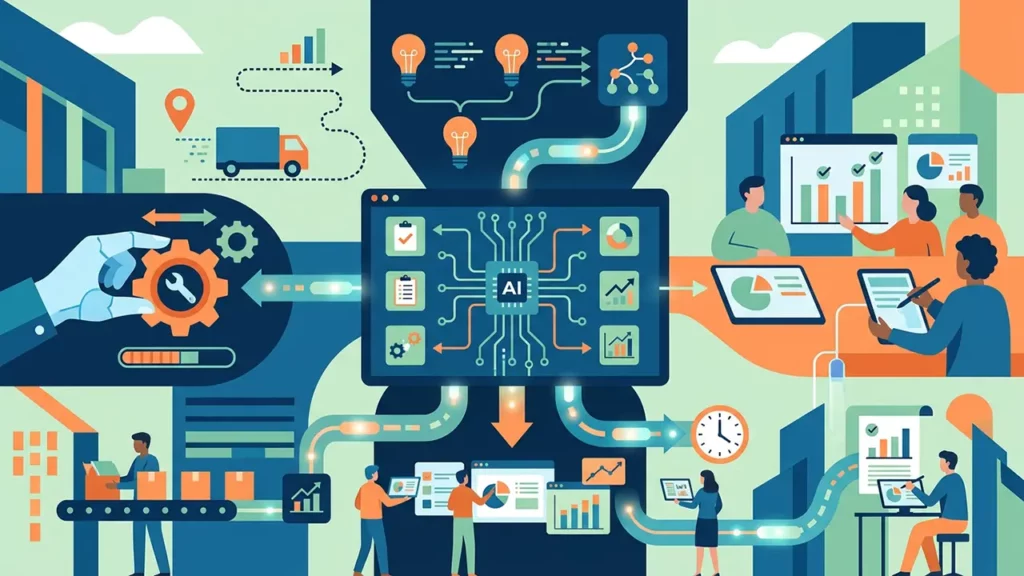
AI workflows serve as the connective tissue that ties individual automated tasks together into cohesive, end-to-end processes spanning multiple tools and teams.
Consider a typical sales workflow as an example: a lead fills out a form on your website, AI scores that lead based on historical conversion data, high-priority prospects are immediately routed to the right sales rep, personalized follow-up emails are scheduled automatically, and the CRM updates itself without anyone lifting a finger.
Each step flows naturally into the next, eliminating bottlenecks and forgotten follow-ups.
How to automate business tasks effectively
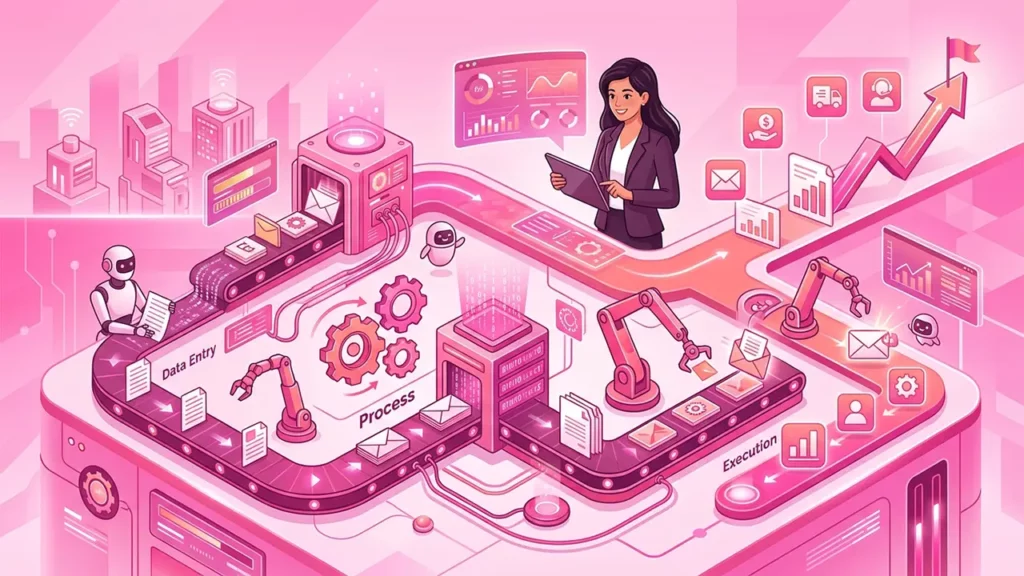
Implementing AI workflow automation successfully requires more than simply purchasing a platform and flipping a switch—you need a thoughtful, phased strategy.
Start with high-impact, repetitive tasks
Begin by identifying the processes that consume the most employee time while offering the least creative or strategic value, as these are your strongest candidates when you want to automate business tasks and demonstrate quick wins.
Choose the right tools and involve your team
Look for workflow automation software that integrates cleanly with your existing tech stack to prevent data silos and adoption friction.
Equally important is involving your team early in the process—train them, gather their input on pain points, and build trust in the system from day one.
Measure results and iterate continuously
Track key metrics such as processing time, error rates, employee satisfaction, and cost savings, then use that data to refine and expand your workflows over time.
According to Gartner:
“By 2026, 30 percent of enterprises will automate more than half of their network activities.” — Gartner
That timeline is fast approaching, and early adopters will hold a meaningful advantage.
Potential challenges to keep in mind

AI workflow automation isn’t without its challenges.
Data quality matters enormously because poor inputs inevitably produce poor outputs, and privacy and compliance requirements add significant complexity in regulated industries like healthcare and finance.
Over-automating too quickly (or relying on AI agents that attempt to replace entire workflows) can also alienate employees who feel their roles are being replaced rather than enhanced.
The best approach is a balanced, phased rollout that prioritizes transparency, governance, and genuine collaboration between human workers and AI systems.
Final thoughts
AI workflow automation isn’t some distant, futuristic concept—it’s a practical reality that businesses of all sizes are leveraging right now to cut costs, reduce errors, and operate more efficiently than ever before.
The organizations that embrace it today are positioning themselves well ahead of competitors who are slower to adapt.
Start small, prove the value with measurable results, and then scale with confidence.