




The question isn’t really whether AI productivity gains are real—it’s how dramatic they actually are. As artificial intelligence tools become embedded in nearly every industry, professionals and business leaders alike are racing to understand what AI productivity truly looks like in practice and whether the hype matches the results.
The short answer? The data is overwhelmingly in AI’s favor.
What the numbers say about AI and efficiency
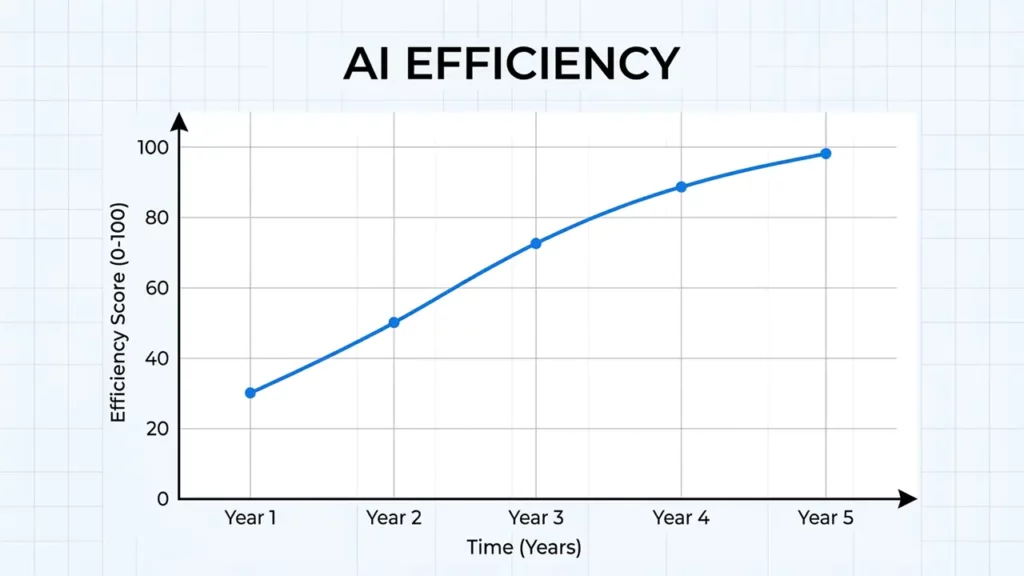
When people ask about the impact of AI on productivity, the statistics paint a compelling picture.
According to a 2023 study by the National Bureau of Economic Research, customer support agents using AI tools saw a 14% increase in productivity, with the biggest gains among less-experienced workers.
Meanwhile, AI efficiency statistics from McKinsey suggest that generative AI could add the equivalent of $2.6 trillion to $4.4 trillion annually across industries.
Those aren’t marginal improvements—they represent a fundamental shift in how work gets done.
Some additional findings worth noting:
- A Harvard Business School study found that consultants using AI completed tasks 25% faster and produced 40% higher-quality results.
- Salesforce reported that 61% of workers believe generative AI helps them be more productive.
- GitHub found that developers using its Copilot tool completed tasks 55% faster than those coding without it.
These numbers make it clear that AI-driven productivity is more than a buzzword.
How AI actually boosts workplace output

Understanding the benefits of AI in the workplace starts with recognizing where the technology shines. AI doesn’t replace human thinking—it removes the friction around it.
Here are some of the most common ways teams are experiencing AI productivity improvements:
- Automating repetitive tasks. Email sorting, data entry, scheduling, and report generation can all be handled or accelerated by AI, freeing workers for higher-value activities.
- Speeding up research and analysis. AI tools can summarize lengthy documents, surface relevant data, and identify trends in seconds rather than hours.
- Enhancing communication. From drafting messages to translating languages in real time, AI streamlines how teams share information. Tools like an AI voice generator can even produce professional narration for training materials or presentations without booking a studio.
- Reducing decision fatigue. By surfacing recommendations and prioritizing information, AI helps professionals make faster, better-informed choices.
Productivity through AI isn’t optional anymore—it’s becoming a competitive expectation.
Where AI makes the biggest difference

Content creation and marketing
Marketing teams are among the earliest and most enthusiastic adopters.
AI helps generate first drafts, brainstorm campaign ideas, optimize ad copy, and personalize content at scale. What once took a team days can now begin in minutes.
Customer service and support
AI chatbots and intelligent routing systems handle common inquiries instantly, allowing human agents to focus on complex or sensitive issues.
The result is faster resolution times and happier customers.
Operations and AI workflows
On the operations side, AI workflows can orchestrate multi-step processes, flag bottlenecks, and allocate resources dynamically.
Teams that integrate AI into their workflows often discover inefficiencies they didn’t even know existed.
AI solving problems in complex environments
In fields like logistics, finance, and healthcare, AI problem solving tools excel at analyzing vast datasets to identify patterns humans would miss.
Whether it’s optimizing supply chains or detecting fraud, AI-enhanced productivity in these contexts saves both time and money.
The limitations worth acknowledging
No honest conversation about AI productivity skips the challenges.
AI tools can hallucinate information, require significant setup time, and introduce new security concerns.
Workers also need training to use them effectively—a step many organizations underestimate.
A 2024 Upwork Research Institute survey found that while 96% of C-suite leaders expected AI to boost productivity, 77% of employees said AI tools had actually increased their workload in some respects, often by adding new tasks related to oversight and quality control.
“The productivity gains from AI are real, but they’re not automatic,” the report noted. “Organizations need to redesign work, not just deploy tools.” — Kelly Monahan and Gabby Burlacu
This is an important nuance. The impact of AI on productivity depends heavily on implementation—how tools are chosen, how teams are trained, and how processes are restructured around new capabilities.
So, does AI actually improve productivity?
The evidence says yes—decisively. But it comes with a caveat.
AI productivity gains are maximized when organizations treat AI as a partner in redesigning work rather than a plug-and-play shortcut.
The teams seeing the biggest returns are those investing in thoughtful adoption, continuous learning, and a willingness to rethink how things have always been done.
The technology is here. The results are measurable. The only remaining question is how quickly you’re willing to adapt.