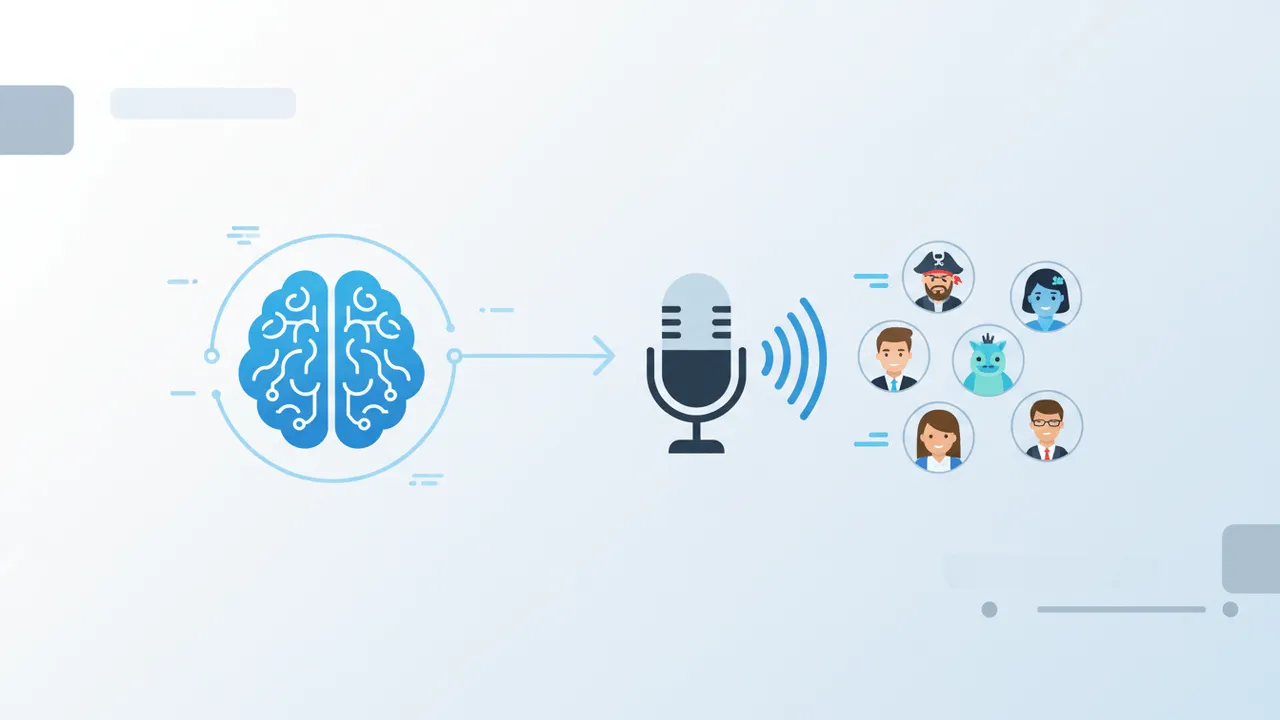





The most popular text-to-speech voices are not necessarily the right voices for every project. A voice that works well for a fast social video may feel too energetic for an audiobook, while a dramatic character voice may distract from a training course. The best choice comes from matching the voice’s tone, pacing, personality, and clarity to your audience and format.
This guide explains the voice styles people commonly look for, how to compare them, and how to narrow a large library into a practical shortlist. For a broader introduction to creating speech from a script, start with text-to-speech online.
What makes a text-to-speech voice popular?
Popular TTS voices tend to be easy to understand, flexible across different scripts, and memorable without overwhelming the message. “Popular” can also mean different things depending on the project. A creator may want a familiar meme-like delivery, while a business team may prioritize a steady, professional narrator.
When evaluating text-to-speech voices, focus on qualities that affect the listening experience:
- Clarity: Can listeners understand the words on a phone speaker or at faster playback speeds?
- Tone: Does the voice sound warm, authoritative, playful, calm, serious, or conversational?
- Pacing: Does its natural rhythm fit short-form content, long narration, or dialogue?
- Expressiveness: Can it support changes in mood without sounding inconsistent?
- Fit for purpose: Does it reinforce the story, brand, audience expectation, or character role?
A recognizable style can help content stand out, but clarity should still come first. If the audience has to work to understand the script, even an entertaining voice can become a barrier.
Common voice styles to explore
Natural conversational narration
A natural, balanced narrator is one of the most useful options in a voice library. This style suits explainers, product walkthroughs, internal learning materials, podcasts, and many types of video narration. Look for smooth phrasing, clear consonants, and a delivery that does not sound overly dramatic.
For projects where realism is the main requirement, compare options designed for realistic voice text-to-speech. Test a voice with a short sample that includes names, numbers, transitions, and a sentence with an emotional shift. That will reveal more than testing a single slogan.
Warm and approachable voices
Warm voices can make instructional, lifestyle, wellness, customer-facing, and community content feel more welcoming. Rather than assigning personality traits to a voice based on gender, choose based on the actual delivery: calm pacing, friendly inflection, and an appropriate level of energy.
If you are exploring transformations or feminine-presenting styles for creative work, see this guide to a female voice changer. The key is to choose a voice that serves the script instead of relying on assumptions about what a particular voice should communicate.
Authoritative announcer and presenter voices
An announcer-style voice generally has firm articulation, controlled pacing, and enough projection to introduce a segment or emphasize a key message. It can be useful for trailers, event openers, sports-inspired videos, promos, and formal narration.
Read more about selecting an announcer voice when the project needs presence without turning every line into a dramatic read. For news-style content, a clear and measured presenter may be a better fit than a highly theatrical announcer. A virtual news anchor format, for example, benefits from concise writing, consistent delivery, and careful review of names and current information.
Character and entertainment voices
Character-led speech can add personality to animation, gaming videos, sketches, social posts, and narrative content. The most effective character voices have a clear role: narrator, hero, sidekick, villain, comic relief, guide, or background personality.
Start by defining the character in a few words, such as “curious young explorer,” “dry sci-fi computer,” or “enthusiastic game-show host.” Then test whether the selected voice remains understandable after adding the energy or emotion the role needs. For more ideas, explore text-to-speech characters and cartoon character text-to-speech.
A childlike delivery can work in age-appropriate storytelling, educational scenes, and fictional dialogue, but it should be used thoughtfully and respectfully. This guide to child text-to-speech covers considerations for finding that style.
Robotic, synthetic, and sci-fi voices
Not every project needs a human-like delivery. Deliberately synthetic speech can establish a futuristic, nostalgic, technical, or comedic mood. A controlled robotic voice may fit a game interface, science-fiction scene, sound effect, or parody better than a conversational narrator.
For a practical starting point, review how to create a robot voice. You can also compare the distinctive style associated with moonbase alpha text-to-speech or learn about the history and creative context behind stephen hawking text-to-speech. Avoid presenting an imitation as if it were the real person speaking.
How to choose from popular TTS voices
A large voice library is more useful when you have a repeatable selection process. Rather than browsing at random, work from the project brief.
1. Define the listener and the listening environment
Consider who will hear the audio, where they will hear it, and what they need to do afterward. A social video may be watched in a noisy setting, while an e-learning module may be heard through headphones. Both need intelligibility, but their pacing and energy can differ.
Write down:
- Audience familiarity with the topic
- Desired emotional response
- Expected playback setting
- Script length and format
- Whether the voice is a narrator, a character, or both
2. Choose a voice role before choosing a voice identity
Instead of starting with “male,” “female,” “young,” or “deep,” define the job the voice must perform. A guide should sound dependable. A fictional character should be distinct from other characters. A narrator should support the information rather than compete with it.
If you are specifically comparing masculine-presenting narration styles, this overview of text-to-speech male voice can help frame your options. For broader casts, use text-to-speech with different voices to plan contrast between speakers.
3. Audition the same script with several voices
Use a representative sample, not a generic sentence. Include the opening hook, a key explanation, a call to action, and any difficult terms. Listen for pronunciation, natural pauses, emphasis, and whether the performance supports the intended mood.
A useful comparison set includes three to five candidates. Too many choices can make it harder to identify meaningful differences. Keep notes on what each option does well and where it feels mismatched.
4. Adjust the script before over-adjusting the voice
Some voice problems are actually writing problems. Dense sentences, unclear transitions, stacked acronyms, and missing punctuation can make synthetic speech harder to follow. Edit for spoken language: use shorter sentences, add purposeful punctuation, and spell out terms when needed.
For content intended to sound especially lifelike, see approaches to human voice text-to-speech. A well-structured script gives any voice more room to sound natural.

Using familiar and fictional voice styles responsibly
Search interest often centers on recognizable character, celebrity, assistant, and meme styles. These can be useful creative references, but they also require care. Do not imply that a public figure, actor, or fictional brand officially endorses your content. Respect platform rules, intellectual property, and consent requirements, especially when creating material that could mislead an audience.
For fictional or genre-inspired projects, these resources can help you explore a style while keeping the creative goal clear:
- A dramatic sci-fi villain concept: darth vader text-to-speech
- Fast, game-inspired energy: sonic text-to-speech generator
- Animated comedy references: spongebob text-to-speech
- Horror-themed delivery: ghostface voice changer and halloween voice changer
- Animation-inspired performance: Anime voice and vocaloid text-to-speech
- Seasonal storytelling: Santa voice
- Pop-culture discussion and context: kpop demon hunters
For references involving real people or widely recognized voices, review guidance on celebrity text-to-speech and kanye west text-to-speech. The same principle applies to assistant-like voices, including siri voice text-to-speech: use the style as creative context, not a claim of affiliation or identity.
Match the voice to the format
The right voice changes with the medium. For short-form social content, prioritize an immediate hook and clear phrasing. For long-form narration, prioritize comfort, consistency, and a pace that remains easy to follow. For games and animation, prioritize contrast between roles so listeners can tell speakers apart.
Meme-oriented content can benefit from intentionally exaggerated timing, but the joke should still be understandable without relying on imitation. Learn more about choosing a text-to-speech meme voice for comedic formats.
A voice may also need to work alongside visuals, music, captions, or an avatar. In those cases, leave space in the delivery. Fast speech can collide with on-screen text, while a highly expressive performance may compete with a busy scene.
Build a practical shortlist in Typecast
Voice discovery is easier when you move from broad categories to a few project-ready candidates. Begin with the role and mood, audition voices against the same script, then save the options that are clearest and most appropriate for the audience.
To explore curated voices by listening rather than guessing from labels, browse Typecast voices. A final review should include the full script, not just the opening lines. Check pronunciation, emotional consistency, transitions between speakers, and whether the final voice still fits the project after editing.
The most useful popular TTS voices are the ones that make the message easier to hear and remember. Choose a voice for its fit, test it in context, and let the script and audience guide the final decision.